


.svg)
.svg)
.svg)
11 Dec 2025

Jakarta, Indonesia – December 11, 2025 – A new research collaboration has been launched to answer a critical question for Indonesia’s commercial freight sector: What does it really cost to own and operate an electric truck or bus compared to a diesel one? The study will examine how government incentives, technological advances, and realworld operations affect the total lifetime costs of electric commercial vehicles in Indonesia.
The International Council on Clean Transportation (ICCT), the Institute for Research on Economics and Society at the Faculty of Economics and Business, University of Indonesia (LPEM UI), and PT. VKTR Teknologi Mobilitas announced the partnership today at University of Indonesia in Jakarta, in conjunction with a public seminar on “Fisal Policy Framework for Zero-Emission Commercial Vehicles in Indonesia”.
The research will examine the factors influencing the TCO of electric commercial vehicles in comparison to conventional vehicles, considering policies and technical aspects.
“Understanding these real-world cost dynamics is essential for designing policies that can accelerate the transition to zero-emission commercial vehicles in Indonesia,” explained Ray Minjares, Program Director at ICCT. “Indonesia’s transition to zeroemission commercial vehicles is a critical step for enhancing energy security, boosting industrial competitiveness, and protecting public health.”
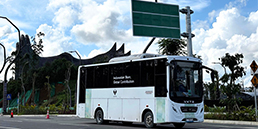
While electric commercial vehicles have lower operational costs, they face significant adoption challenges. High initial purchase costs, uncertain resale values, and limited financing options are major barriers in Indonesia’s market where electric trucks and buses can cost twice as much as their diesel counterparts.
Commercial trucks and buses, although they make up about 6% of the national fleet, they account for 57% of fuel consumption and contribute disproportionately to transport-related emissions, due in large part to their reliance on subsidized fuels.
The research aims to provide insights on three critical factors shaping effective policy:
- The comparison of TCO between zero-emission commercial vehicles and their diesel counterparts
- The impact of current fiscal policy on the TCO of electric commercial vehicles
- The vehicle segments that are most ready for electrification today
At the launch event, Alin Halimatussadiah from LPEM FEB UI explained that Indonesia has a significant opportunity to capture economic value through the development of local manufacturing for electric buses and trucks. “The current momentum supports the transition from conventional to electric commercial vehicles. Many diesel trucks and buses are aging and need to be replaced. Furthermore, many regions are expanding public transportation services by using buses as part of their decarbonization programs,” she explained.
According to Alin, this real demand creates a significant opportunity for Indonesia to capture the economic benefits of developing domestic electric heavy-duty vehicle manufacturing.
Meanwhile, V. Bimo Kurniatmoko, Director of VKTR, explained that fiscal policy can make domestic electric commercial vehicle production more competitive. “Fiscal incentives will support domestic production of electric commercial vehicles and help control the total cost of ownership, including both initial and operational costs. Furthermore, they will also improve access to spare parts for vehicle owners,” he added.
In addition to decarbonization, expanding the zero-emission commercial vehicle fleet can bring broader benefits such as better air quality, safer roads and the foundation for like low-emission zones in major cities.
About VKTR
PT VKTR Teknologi Mobilitas Tbk. (VKTR – pronounced “Vector”) is a pioneer in the electrification of the commercial vehicle segment in Indonesia. VKTR officialy listed its shares on the Indonesia Stock Exchange on June 19, 2023, becoming the first commercial EV issuer in the country. VKTR is committed to accelerating sustainable mobility through manufacturing innovation and strategic partnerships with the world’s leading electric vehicle manufacturers.
For further information, please contact:
VKTR Investor Relations
ir@vktr.id
For media inquiries, please contact:
VKTR Corporate Communications
media.relations@vktr.id