


.svg)
.svg)
.svg)
18 Nov 2025
Understanding NZE 2060 and Indonesia’s NDCs and How VKTR Drives the Transition.
In the global race against climate change, Indonesia stands at a pivotal crossroads. As the world’s sixth-largest emitter of greenhouse gases, the nation has committed to an ambitious goal: achieving Net Zero Emissions (NZE) by 2060. This long-term vision aligns Indonesia with global efforts to keep warming below 1.5°C, while balancing the realities of a developing economy powered by energy-intensive industries and rapid urban growth.
But what does Net Zero Emission 2060 really mean and how does it connect to Indonesia’s Nationally Determined Contributions (NDCs)?
Indonesia’s Climate Commitments: A Path to 2060
Under its Enhanced NDC (2022), Indonesia pledged to cut greenhouse gas emissions by 31.9% unconditionally, and up to 43.2% with international support, by 2030 relative to business-as-usual levels. These commitments form the foundation for the country’s NZE 2060 target, an economy-wide transformation where emissions from energy, transport, industry, and land use must all drastically decline.
Yet, according to BloombergNEF’s Indonesia Transition Factbook 2025, reaching this target requires more than incremental change. To align with global net-zero pathways, Indonesia’s energy-related emissions must fall by 21% by 2030 and 49% by 2035. This means a deep, structural shift toward clean power, transport electrification, and energy efficiency - sectors that together account for nearly half of Indonesia’s total emissions.
Transport: The Frontline of Decarbonization
Transportation remains one of Indonesia’s largest and fastest-growing emission sources. The road transport sector alone contributed 22% of national emissions in 2024, making electrification all the more essential.
Electrifying transport is a crucial step in meeting Indonesia’s Net Zero 2060 commitment and achieving its NDCs. The government’s roadmap places the transport sector, especially public transportation, at the center of national decarbonization efforts. Public buses, operating daily across urban centers, represent one of the highest-impact opportunities to cut emissions quickly at a scale.
Indonesia’s Net Zero roadmap envisions:
- 90% of public transport electrified by 2030
- Full urban transport electrification by 2040
- Complete electrification of public transport by 2045
However, adoption remains low. Out of nearly 170 million registered vehicles, fewer than 300,000 are electric, translating to an EV penetration rate below 0.2%. Bridging this gap is one of the nation’s greatest sustainability challenges and opportunities.
At the forefront of this transformation stands PT VKTR Teknologi Mobilitas Tbk (VKTR), a commercial electric vehicle company built to accelerate Indonesia’s shift to clean mobility. With operations spanning local assembly, body manufacturing, distribution, and after-sales services, VKTR provides the end-to-end ecosystem Indonesia needs to scale EV adoption.
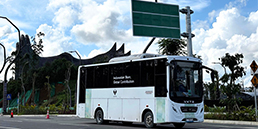
As part of this commitment, VKTR has supplied 105 electric buses for Transjakarta, supporting Jakarta’s public transport electrification program, and electric compactor trucks for Ibu Kota Nusantara (IKN) to enable sustainable waste management in Indonesia’s future capital city. Currently, VKTR is also preparing to provide compactor trucks for the Jakarta Provincial Government (Pemprov DKI Jakarta), further advancing the electrification of critical public service vehicles nationwide.
Beyond Public Transport: Electrifying the Nation’s Workhorse Fleets
As Indonesia advances toward its Net Zero 2060 vision, the main challenge is about execution. Achieving decarbonization will demand strong collaboration across industries, policies that encourage clean innovation, and companies willing to take the lead in building solutions that are both scalable and sustainable.
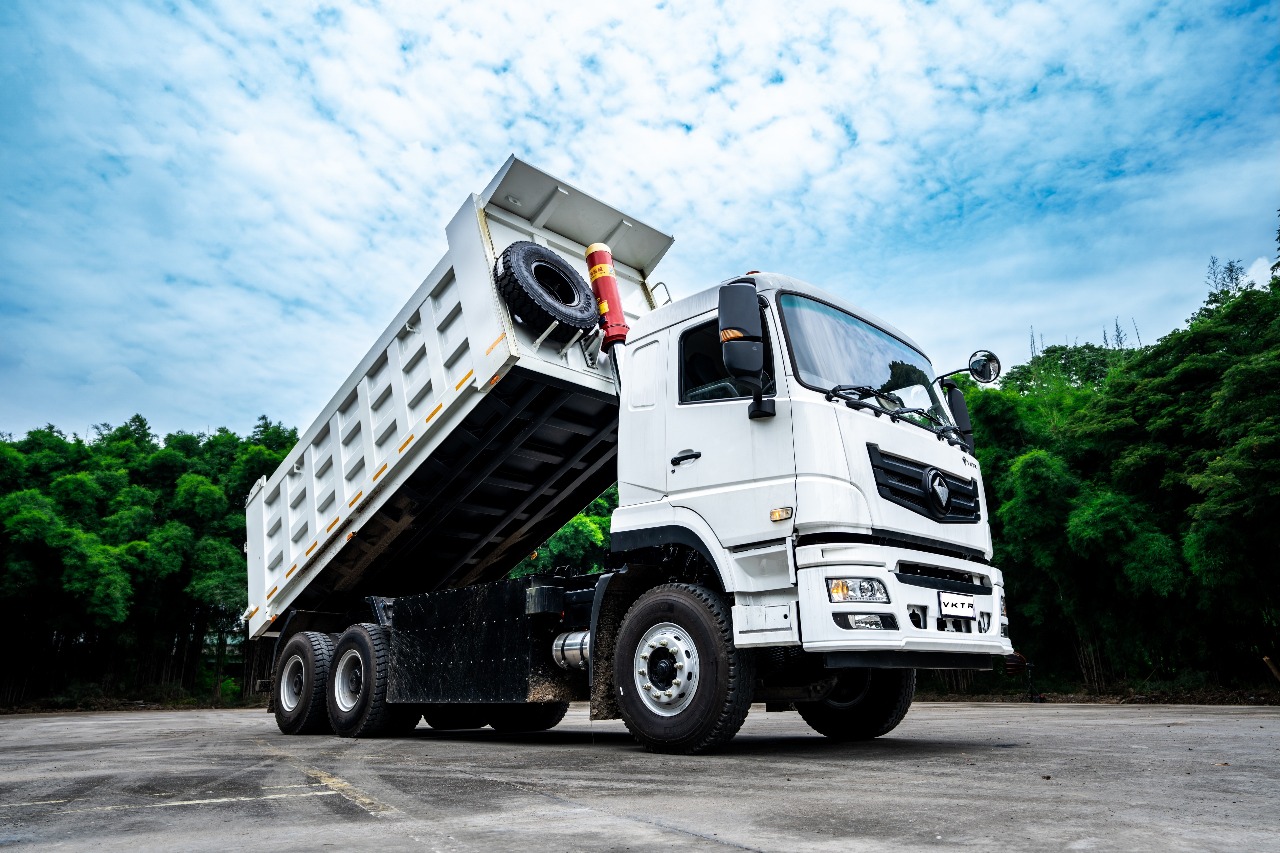
VKTR aims to electrify more vehicles across Indonesia, not only in public transportation but in heavy mobility across all sectors. By expanding electrification to logistics, construction and public service fleets, VKTR seeks to enable a broader ecosystem of clean mobility that supports Indonesia’s economic and environmental goals.
This is where VKTR’s purpose becomes clear. By harnessing local expertise, developing homegrown technologies, and driving electrification from the ground up, VKTR proves that sustainable progress can begin in Indonesia and extend its impact globally. Each electric bus, truck, and mobility solution produced locally contributes not only to national emission targets but also to a broader global effort to combat climate change.
For media inquiries, please contact:
VKTR Corporate Communications (media.relations@vktr.id)